



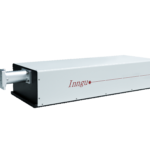






The high-repetition-rate tunable pulsed laser is a high-performance optoelectronic light source designed for high-precision nonlinear optical measurements and ultrafast spectroscopic analysis, with optimized performance specifically catering to the rigorous experimental demands of modern coherent Raman spectroscopy. Conventional optical parametric oscillator (OPO) laser systems typically adopt a discrete configuration, where the pump source, resonant cavity, wavelength tuning unit, and electrical control subsystem are installed as separate and independent units. Such a separated structure inevitably results in bulky system volume, complicated optical alignment, cumbersome assembly procedures, and poor overall operational stability. In contrast, this advanced pulsed laser implements a deep integration design that tightly merges the high-stability pump source and high-precision OPO functional module into a single monolithic unit. This innovative architectural design comprehensively optimizes the internal optical layout, mechanical structure, thermal management system, and synchronous electrical control logic. Consequently, the laser features an ultra-compact footprint, streamlined internal optical paths, and greatly simplified external interfaces, effectively overcoming the inherent drawbacks of traditional split-type OPO lasers and significantly improving system integration and practical usability for scientific experiments.
From the perspective of structural engineering and practical experimental application, the deep integration of pump and OPO modules delivers prominent advantages in system miniaturization, operability, and environmental adaptability. Traditional discrete pump-OPO combinations require independent installation, precise spatial positioning, and repeated beam calibration between separate devices, which not only occupies valuable laboratory optical platform space but also relies heavily on professional operational experience to achieve accurate beam coupling and parameter matching. This poses high technical barriers and long debugging cycles for routine spectroscopic experiments. In comparison, the proposed high-repetition-rate tunable pulsed laser encapsulates all core optical components, driving circuits, precision temperature control modules, and signal synchronization units within a unified sealed chassis. The internal optical path is meticulously optimized via professional ray tracing and finite element optical simulation, eliminating redundant optical transmission segments and unnecessary mechanical adjustment structures. The high-rigidity integrated mechanical structure effectively suppresses micro-displacement caused by external mechanical vibration and ambient temperature fluctuations, ensuring long-term optical path stability. Furthermore, the laser adopts standardized and highly simplified external interfaces, including unified power supply ports, high-speed synchronous trigger terminals, universal data communication interfaces, and quick-connect cooling ports. Researchers can complete system wiring and deployment in a single step without repeated optical calibration, drastically reducing experimental preparation time and improving the stability and repeatability of experimental conditions.
This integrated laser system excels in broadband tunable parametric pulse output, serving as a core performance advantage that distinguishes it from fixed-wavelength lasers and low-precision tunable light sources. Supported by a high-stability customized pump source and an optimized OPO nonlinear frequency conversion system, the device realizes continuous, smooth, and wide-range wavelength tuning of parametric output pulses. Its broadband spectral coverage encompasses the characteristic molecular vibrational fingerprint regions of organic compounds, inorganic functional materials, biological macromolecules, nanocatalysts, and polymer materials. The flexible wavelength tuning capability enables adaptive matching of excitation wavelengths for diverse spectroscopic experiments, covering both near-infrared bands suitable for non-invasive biological detection and mid-infrared fingerprint bands dedicated to molecular structural analysis. Such versatile tuning performance greatly expands the application boundary of coherent Raman spectroscopy, enabling multi-band, multi-component, and multi-scenario spectral detection and characterization that cannot be achieved by conventional single-band laser sources.
Stable high-repetition-rate pulse output across the entire tuning spectrum further enhances the laser’s applicability for high-sensitivity coherent Raman detection. Benefiting from the fully integrated synchronous control architecture, the pump laser and OPO module share a unified high-precision clock system, achieving strict temporal synchronization between pump excitation and nonlinear parametric conversion. Unlike discrete laser systems that suffer from repetitive frequency drift and asynchronous signal interference, this laser maintains highly uniform and stable pulse sequences in the time domain throughout the full wavelength tuning range. The high repetition rate design effectively elevates the average output optical power while maintaining low single-pulse energy, which is critical for experimental safety and sample protection. It effectively avoids photobleaching and photodamage to fragile biological tissues, living cells, and low-dimensional nanomaterials induced by high single-pulse energy. Meanwhile, the increased average power significantly enhances the excitation efficiency of weak Raman scattering signals, improves the signal-to-noise ratio of spectral detection, and enables high-sensitivity recognition of trace substances and high-contrast micro-area spectral imaging.
The system delivers superior near-diffraction-limited beam quality, which is essential for high-resolution coherent Raman microscopic imaging. The internal optical path incorporates precise mode-matching design and multi-stage Gaussian beam shaping components, which effectively filter out higher-order transverse modes and optimize the spatial energy distribution of the output laser beam. After efficient OPO nonlinear frequency conversion, the generated parametric pulses exhibit ideal Gaussian beam characteristics, featuring ultra-low divergence angle, uniform near-field and far-field energy distribution, and negligible optical distortion and stray light. The excellent beam quality allows the laser beam to be tightly focused into an ultra-fine diffraction-limited micro-spot through high-numerical-aperture microscope objectives. This enables sub-micron spatial resolution in micro-area spectral detection and imaging, supporting high-precision structural characterization of two-dimensional materials, nanoparticle aggregates, and material surface micro-defects, as well as in-situ subcellular structural analysis in biological research, ensuring outstanding spatial accuracy and imaging contrast in Raman microscopic measurements.
Outstanding long-term stability of output power and central wavelength further guarantees reliable and repeatable spectroscopic experimental results. Traditional discrete OPO lasers are susceptible to performance drift caused by inconsistent temperature control of pump and OPO components, mechanical relaxation, and environmental interference, leading to poor experimental repeatability. In contrast, this integrated laser adopts a unified precision thermal management solution, achieving synchronous constant-temperature control for both the pump gain medium and OPO nonlinear crystal. The built-in high-precision liquid cooling system precisely stabilizes the temperature of core optical components, effectively suppressing power attenuation and wavelength shift induced by thermal accumulation and ambient temperature variation. Moreover, the laser is equipped with a full closed-loop active stabilization system. High-sensitivity photodetectors and miniature spectral sensors monitor real-time output power and wavelength parameters. Once subtle parameter drift is identified, the system automatically implements dynamic compensation by adjusting pump driving voltage, crystal temperature, and grating tuning position. This real-time feedback control ensures ultra-stable long-term operation, with extremely low power fluctuation and wavelength drift, supporting long-cycle continuous spectroscopic experiments and greatly improving data reliability and reproducibility.
A core technical highlight of this laser system is its jitter-free parametric pulse output, which solves the long-standing timing jitter problem of traditional discrete pump-OPO systems. In conventional separated configurations, pump pulse generation and OPO parametric conversion are controlled by independent circuit systems with unsynchronized clock signals, resulting in inevitable nanosecond-scale timing jitter between excitation and output pulses. Such temporal instability causes severe signal fluctuations in time-resolved ultrafast Raman spectroscopy, distorts the dynamic evolution curves of molecular vibrational states, and even leads to invalid experimental data. By virtue of the deep integration design, the pump modulation and OPO resonant cavity control of this laser share a single ultra-low-jitter reference clock. All pulse triggering, phase locking, and wavelength tuning signals are derived from the same synchronous timing system, completely eliminating asynchronous temporal deviation. The resulting jitter-free parametric pulses provide ultra-stable time-domain excitation conditions, which are indispensable for high-precision ultrafast pump-probe experiments, time-resolved molecular vibrational dynamic detection, and transient chemical reaction process tracking.
Combining its compact integrated structure, simplified system deployment, broadband tunability, high repetition rate, superior beam quality, excellent long-term stability, and jitter-free pulse output, this high-repetition-rate tunable pulsed laser is highly specialized and uniquely suitable for all mainstream research directions of coherent Raman spectroscopy. It has been widely adopted in numerous frontier research fields, including stimulated Raman scattering microscopy, coherent anti-Stokes Raman scattering spectroscopy, broadband multiplex spectral detection, in-situ molecular fingerprint analysis, and ultrafast molecular vibrational dynamics research. In biophotonics, the laser enables label-free, non-invasive, high-resolution dynamic imaging of living cells and biological tissues, avoiding phototoxicity while maintaining high detection sensitivity. In materials science, its full-spectrum tuning capability and stable output performance meet the structural characterization and performance analysis requirements of semiconductor materials, two-dimensional layered materials, catalytic nanomaterials, and polymer thin films. In physical chemistry and analytical chemistry, it provides high-precision, time-stable excitation light sources for exploring intermolecular energy transfer, transient reaction intermediates, and trace substance detection. Overall, this integrated laser effectively compensates for the performance deficiencies of traditional discrete OPO light sources, provides a more stable, efficient, and user-friendly technical platform for coherent Raman spectroscopy research, and possesses great application value and broad prospects in frontier scientific research and advanced optical detection fields.