




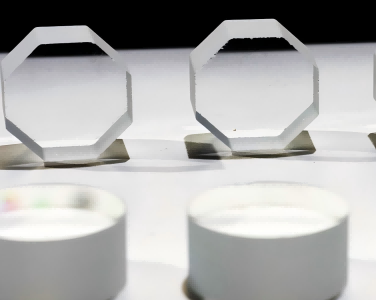


High Power IR Nanosecond Laser for Glass Drilling
Introduction
As global manufacturing accelerates its transformation toward intelligent and low-carbon production, the glass precision processing industry faces ever-increasing demands for higher efficiency, superior precision, and environmental sustainability. Traditional mechanical drilling methods, which rely on contact-based tools such as diamond drills and grinding wheels, often result in micro-cracks, edge chipping, poor processing quality, and environmental contamination. High-power infrared (IR) nanosecond fiber lasers have emerged as a transformative solution for glass drilling, offering non-contact, high-precision, and high-efficiency processing capabilities.
Key Advantages Over Conventional Methods
1. Superior Edge Quality
Laser drilling produces significantly smaller edge chipping compared to mechanical methods. In practical applications, using an IR nanosecond laser to drill an 8 mm diameter hole through 8 mm thick glass achieves a chipping dimension of only 85 μm, delivering excellent edge quality.
2. High Efficiency with Non-Contact Processing
Laser processing requires no direct contact with the workpiece, eliminating mechanical stress and preventing secondary contamination or material damage. Non-contact drilling also allows for high-speed operation with minimal downtime.
3. Exceptional Flexibility
Unlike conventional drilling restricted by tool geometry, laser drilling can produce complex geometries including round holes, square holes, tapered holes, and customized shaped holes in a single process step.
Technical Principles
The infrared nanosecond laser operates at a wavelength of 1064 nm, generating nanosecond-scale pulses that enable precise material removal through a combination of photothermal and photomechanical effects. When the laser beam interacts with the glass surface, photothermal absorption induces localized heating that melts or vaporizes the material, while photomechanical shockwaves produce micro-explosive fractures that form cavities.
A well-established technique for glass drilling leverages the high optical transparency of glass by focusing the laser beam on the bottom surface, then moving it upward layer by layer. This approach achieves near-zero taper and superior hole consistency.
Advanced Design Features
High Peak Power Capability
Conventional pulse fiber lasers typically offer peak powers in the 10 kW range, which are adequate for metal marking but insufficient for glass drilling. The latest-generation IR nanosecond lasers deliver over 200 kW of peak power while maintaining exceptional beam quality, satisfying the peak power density requirements for glass processing.
Exceptional Beam Quality
With an M² beam quality of less than 1.3, these lasers achieve superior focusing performance, which significantly improves material processing efficiency and minimizes edge chipping during drilling operations.
Anti-Reflection Design
A unique anti-reflection design ensures stable, long-term operation even when processing highly reflective materials such as glass and smart mirrors. Carefully selected and tested components prevent back-reflection damage that would cause conventional lasers to fail.
Robust Stability and Reliability
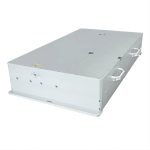
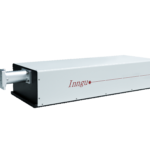
With a low failure rate and consistent output performance, these lasers reduce downtime and boost overall manufacturing productivity. Many models feature an all-in-one compact design with minimal pulse jitter and excellent energy stability, making them suitable for virtually any system integration.
User-Friendly Operation
Custom-developed software enables real-time monitoring of laser status, supports seamless switching between internal and external control modes, and allows multi-layer and multi-parameter processing to accommodate diverse production requirements.
Processing Capabilities
Material Compatibility
IR nanosecond lasers are compatible with a wide range of glass types, including:
-
Soda-lime glass (float glass)
-
Low-iron ultra-clear glass
-
Borosilicate glass
-
Quartz glass
-
Sapphire glass
-
Coated or laminated glass substrates
Hole Dimensions and Quality
-
Minimum hole diameter: 20 μm
-
Maximum hole diameter: 500 μm (up to 150 mm for larger applications)
-
Single-side drilling thickness: up to 20 mm
-
Edge chipping: < 0.5 mm (as low as 85 μm in optimized processes)
-
Hole wall roughness: Ra < 1 μm
-
Minimal heat-affected zone (HAZ) with crack-free edges
For 5 mm thick ultra-clear glass, holes of 10–40 mm diameter can be drilled with consistent chipping below 350 μm. In thicker 6 mm glass, 50 mm diameter holes also achieve chipping below 350 μm. For photovoltaic glass, a 12 mm hole can be drilled in just 2.5 seconds with a smooth bore wall and chipping below 300 μm.
Industrial Applications
High-power IR nanosecond laser glass drilling systems have been widely adopted across multiple industries:
Consumer Electronics
-
Precision drilling of speaker holes, microphone holes, and camera holes in smartphone and smartwatch cover glass
-
Slotting and chamfering operations for display panels
-
High-density micro-hole arrays for electronic components
Home Appliances and Kitchenware
Solar Energy
Automotive Industry
-
Drilling for automotive sensors and camera cover lenses
-
Precision holes for functional elements and light modules
Medical and Microfluidic Devices
-
Micro-holes for diagnostic systems and lab-on-a-chip applications
-
Precision drilling for microfluidic components and analysis chips
Semiconductor Industry
-
Drilling and scribing for semiconductor material processing
-
Wafer dicing for optoelectronic applications